Less than 40 per cent of counties cover health costs for persons with disabilities - report
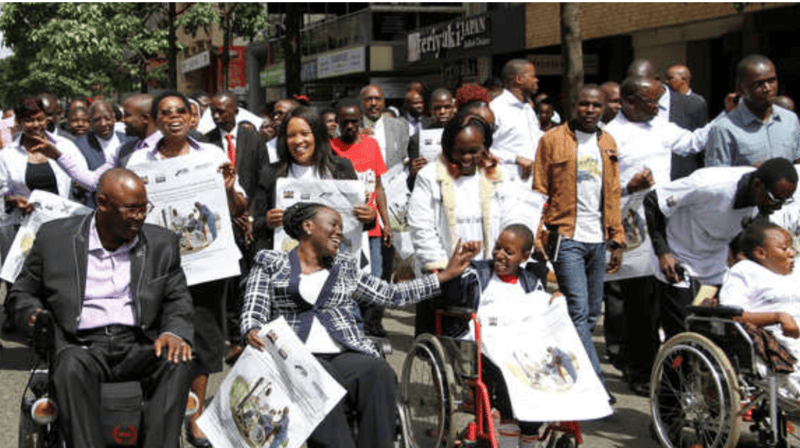
While 23 counties have county-level health insurance schemes, only 15 counties provide free or subsidised coverage to ensure persons with disabilities can afford care.
Only 15 or 37.5 per cent of Kenya’s counties have put in place free or subsidised health insurance coverage for persons with disabilities, a new report by the National Council for Persons with Disabilities (NCPWD) shows.
In its findings, the Council noted that this limited rollout is restricting access to affordable healthcare for many, leaving millions without the support they need to meet higher medical costs.
More To Read
- Inquiry reveals Mombasa's government buildings still inaccessible to PWDs
- Only 4 per cent of public institutions meet disability hiring quota - survey
- MPs push for faster completion of disability equipment factory to improve access to learning materials
- Senators grill Mombasa governor over poor accessibility to public buildings for PWDs
- Senate probes barriers facing PWDs in accessing services in Mombasa County
- PS Oluga warns stigma denying thousands of PWDs vital health services
The disability inclusion assessment, conducted across 41 of the country’s 47 counties, found that while 82.9 per cent, equivalent to 34 counties, have taken specific steps to improve healthcare access for persons with disabilities, significant gaps remain.
The steps include improving physical access to health facilities, providing disability-specific medical support and introducing inclusive health communication strategies.
Currently, 85.4 per cent of counties provide essential mobility and support equipment such as wheelchairs, white canes, hearing aids and prosthetics. Of these, 91.4 per cent offer the devices free of charge, removing a major financial barrier that has historically prevented many persons with disabilities from living independently and participating fully in society.
“These findings suggest that most county governments recognise the need to address disability-related healthcare access. However, the seven county governments without any reported interventions represent a significant gap,” reads the report.
“This raises concerns about potential inequality in healthcare delivery and the need for national-level guidance to ensure universal health access for all persons with disabilities.”
The report further reveals that nearly three-quarters of counties (73.2 per cent) provide rehabilitation services, with physiotherapy universally available in counties offering such care. Additionally, 68.3 per cent of counties provide disability assessment services free of charge, enabling access to benefits and support programs.
Despite the advances, gaps persist. While 23 counties have county-level health insurance schemes, only 15 counties provide free or subsidised coverage to ensure persons with disabilities can afford care.
“The absence of such schemes in nearly half the county governments limits access to affordable and inclusive healthcare, particularly for persons with disabilities who often face higher medical needs and costs,” reads the report.
Rehabilitation services are also uneven. Only 43.3 per cent of counties provide speech-language and audiology therapy, and just 13 counties offer the full spectrum of rehabilitation services, including physiotherapy, occupational therapy, mental health support, orthopaedic technology and speech therapy.
Geographic inequality compounds these challenges, as specialised healthcare is concentrated in urban centres, excluding rural populations who face both distance and cost barriers. Community-based rehabilitation programs exist in only a few counties.
Among counties offering free disability assessments, only 53.6 per cent have anchored the policy in law, leaving the services vulnerable to budget cuts or policy reversals. While 68.3 per cent of counties have waiver mechanisms to exempt vulnerable populations from healthcare costs, implementation remains inconsistent.
Kenya has made notable policy commitments toward disability inclusion in recent years. However, for millions of persons with disabilities, everyday life is still marked by exclusion rather than access. According to the national census, about 2.2 per cent of Kenyans, roughly 900,000 people aged five and above, live with some form of disability.
Women are disproportionately affected, and mobility and visual impairments are the most common. Household surveys indicate up to 15 per cent of Kenyans report at least one functional difficulty, highlighting weaknesses in disability data systems.
Economic exclusion is another entrenched challenge. The report shows that Persons with disabilities are more likely to live in poverty and have limited access to stable employment.
Despite legal provisions requiring inclusive hiring, persons with disabilities make up only 1.3 per cent of the public-sector workforce. Without income security, households face compounded vulnerability from disability-related costs such as assistive devices, transport and ongoing care. Social stigma and misinformation continue to shape attitudes in homes, schools, workplaces, and public institutions.
“This assessment gives us a clear baseline. We can now see where counties are succeeding and where urgent action is needed. The next step is to move from assessment to action—to ensure every county is equipped and committed to serving all its citizens, including those with disabilities,” Labour CS Alfred Mutua said in the report’s foreword.
Top Stories Today